Discussions about black holes typically focus on their event horizons and singularities, which are fundamental aspects of their definition. However, the concept of a black hole may not necessarily require a singularity, leading to the intriguing possibility that such entities could exist without an event horizon as well.
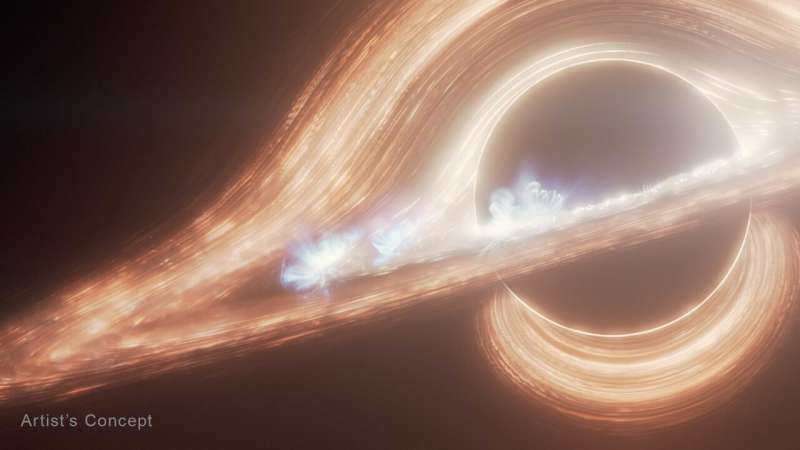
To understand this topic better, it is essential to differentiate between two types of black holes. The first group consists of theoretical black holes described by general relativity. These theoretical constructs stem from solutions to Einstein”s field equations, referred to as metrics. The most notable early metric was formulated by Karl Schwarzschild, characterizing a basic, non-rotating black hole. Subsequent discoveries, like the Kerr metric identified by Roy Kerr in 1963, expanded these concepts to include rotating black holes, famously visualized in popular media such as the film “Interstellar.”
The second category includes black holes that have been directly observed, including M87* and the one located at the center of our own galaxy, SagA*. Data collected by the Event Horizon Telescope has provided insights into these black holes, revealing that they rotate and exhibit a structure near their horizons that aligns well with the Kerr model. Nevertheless, our observations do not penetrate the black holes themselves, leaving the existence of singularities uncertain. Furthermore, we cannot observe the event horizon directly since any light that crosses it becomes permanently trapped.
While current evidence does not contradict the existence of singularities or event horizons in black holes, alternative models that comply with existing observations could be theoretically plausible. The significance of this discussion lies in the complications that singularities and event horizons introduce. A singularity, defined as a point of infinite density with zero volume, presents a breakdown of physical laws, leading physicists to propose the cosmic censorship hypothesis. This suggests that singularities are always hidden behind event horizons, thus avoiding direct confrontation with their problematic nature.
Event horizons themselves foster issues, particularly the information paradox, which arises because any matter crossing an event horizon becomes irretrievably lost to the universe. This paradox presents a conceptual conundrum that has prompted researchers to explore black hole models devoid of singularities and event horizons. Since general relativity is a classical framework, the quest for a quantum theory of gravity is increasingly pertinent, and there is growing evidence that quantum mechanics might address these challenges.
For instance, Heisenberg”s uncertainty principle implies that precise definitions of mass at pinpoint locations are unattainable, suggesting that singularities might not form under quantum conditions. Moreover, Hawking radiation proposes a mechanism through which energy and information could escape from black holes over time.
Current theoretical investigations often emphasize quantum phenomena. In loop quantum gravity, the structure of spacetime at the quantum level may allow for the formation of a “Planck star” at the center of a black hole instead of a singularity. Similarly, string theory introduces the concept of a fuzzball, where singularities are replaced by a mass of degenerate strings.
Alternatively, classical models that deviate from general relativity have been proposed to circumvent the challenges posed by singularities. One such model is known as the Hayward metric, which represents a minimal solution to Einstein”s field equations under specific conditions: static, asymptotically flat, spherically symmetric, and non-singular. In essence, a Hayward black hole resembles a non-rotating Schwarzschild black hole that excludes singularities.
This variance results in several crucial differences. Most notably, a Hayward black hole lacks a singularity; its center remains locally flat, akin to regions in deep space. Additionally, rather than an event horizon, this model features an apparent horizon that can retain matter for extended periods, permitting energy and matter to gradually escape. This phenomenon is reminiscent of Hawking radiation but does not necessitate quantum physics for its explanation. For supermassive black holes, the differentiation between a Hayward black hole and a Schwarzschild black hole would be minuscule.
While observational evidence supports conventional models, Hayward black holes also align with current data. The caveat remains that no known physical mechanism has been identified to prevent singularities from forming; the Hayward model simply prohibits them by definition. If this model holds true, the complexities surrounding singularities and event horizons could ultimately be rendered irrelevant.